Archives

A Tale of Turkey Tail

Turkey Tail 1-7-13_15

Turkey Tail Mushroom

It may well be winter but the pantry is stocked full of treasures gathered and dried throughout the summer and fall. Turkey Tail mushroom is one of those treasures. Considered a functional food and medicine it has been used for centuries in Asia, Europe and by indigenous peoples in North America.  I discovered it in the same manner that I discover many of the medicinal plants that show up for use in my herbal practice – when a need for that particular medicine arises.

A friend and hiking buddy of mine recently passed away after battling esophageal cancer and shortly thereafter, another friend received the same diagnosis. It left me asking, “why?” I was already aware of my talented artist friend’s long suffering with Hepatitis C, and a musician friend suffering with the same. Both were seeking alternatives. I found myself asking, “How can I help?” In answer to that question someone shared a TED Talk video on Facebook, Paul Stamets: 6 ways mushrooms can save the world. And if that wasn’t enough to get my attention, CNN picked up the story and aired a shorter video called “The ‘Forbidden Fruit’ of Medicinal Mushrooms,” with mycologist, Paul Stamets. That is how I came to learn of Turkey Tail mushroom and it’s ability to assist in remediating certain viral conditions and cancers.

Turkey Tail_2154

Turkey Tail, left; False Turkey Tail (Stereum ostrea) right

Not only did Paul talk about Turkey Tail mushroom, but he also shared the story of his mother’s stage IV breast cancer that had metastasized to her liver. The oncologist, who was a woman, said it was the second worst case of breast cancer she had seen in 20 years of practice. She predicted that Paul’s mother had less than 6 months to live. She also told them about a new study using Turkey Tail mushroom to cure cancer. One year later after a course of Turkey Tail mushroom in addition to the standard drugs Taxol (paclitaxel) and Herceptin (trastuzumab), she had no detectable cancer.

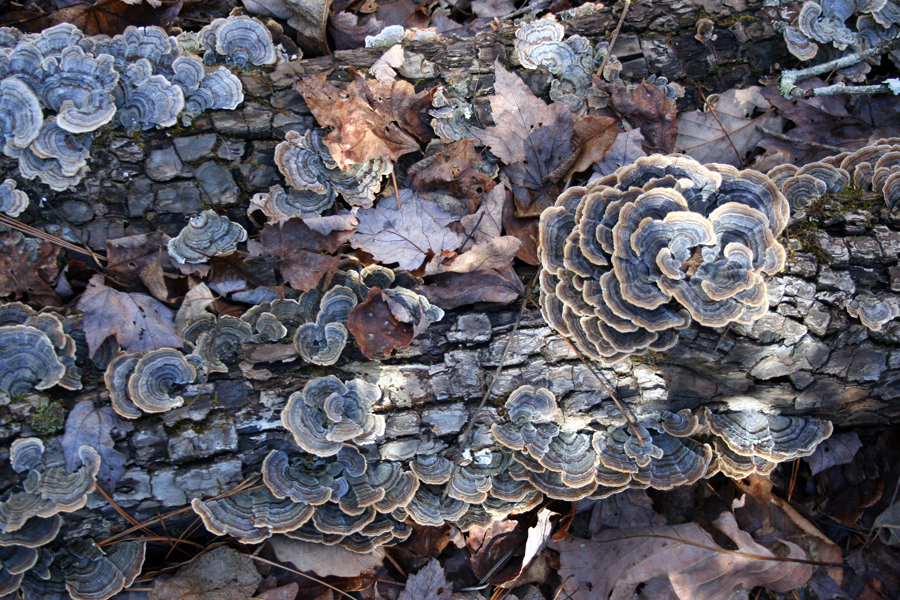
Turkey Tail mushroom, whose botanical name is Trametes versicolor, for its wide variety of colors, resembles a wild turkey tail. It is a member of the polypore family because it emits spores from pores on the underside of the leathery cap. It has long been used in China as a medicine where it is known as Yun Zhi. In Japan where it also has a long history of use is known as kawaritake, or “cloud mushroom” for the image it invokes of billowing clouds. In traditional Chinese Medicine Turkey Tail is used to clear dampness, reduce phlegm, heal pulmonary disorders, strengthen the stomach and spleen, increase energy and benefit people with chronic diseases. Chinese medical doctors consider it a useful treatment for infection and/or inflammation of the upper respiratory, urinary and digestive tracts. It is also regarded as a curative to chronic active hepatitis and is used to treat general weakness of the immune system.

turkeys

Wild Turkeys in New Mexico

Turkey Tail is incredibly abundant and may be some of the most common mushrooms found on the planet.  Any time a plant is “common” you can be assured that it is the people’s medicine that is needed at that time. It is found virtually anywhere that there are dead hardwood logs and stumps. Lucky for me, it grows in the woods all around my house. I gather it all year long, dry it in paper bags and store it in a glass jar.

Wild Turkey Tail has a lifespan of a year or two but persist years after they die, attracting and harboring a succession of other organisms. They generally stay potent for many years. Actions include: Anti-tumor, Anti-Viral, Anti-microbial, Immunomodulating, Anti-oxidant, and it has been found to be effective for immunodeficiency, and against multiple types of cancers, Hepatitis B & C, and malaria.

Hot water extracts known as decoctions extract the rich immune supporting polysaccharides common to all medicinal mushrooms. Decoction is the only clinically validated method for breaking these polysaccharides out of indigestible cell walls. Hot water dissolves the indigestible fiber, chitin, which is a derivative of glucose and is also found in the outer skeleton of lobster. Most hot water mushroom/mycelium extracts are at least a 20:1 concentration.

The anti-cancer polysaccharide found in Turkey Tail is polysaccharide-K (PSK.) PSK fights cancer tumors by inhibiting growth of cancer cells, stimulating immune response and enhancing the population and activity of NK cells and other lymphocytes.  It is often used in conjunction with chemotherapy and radiation treatments as a non-toxic therapy to boost immune function (depressed by chemo and radiation), and to increase cancer survival rates. PSK has shown to be beneficial as adjuvant therapy in the treatment of gastric, esophageal, colorectal, sarcoma, carcinoma, breast, cervical, prostate and lung cancers, which is very good news indeed.
Turkey Tail_2299

So where my mind goes with this is, why just an adjuvant therapy? If radiation and chemo depresses the immune system and Turkey Tail boosts it while at the same time supporting and protecting the body against cancer, could Turkey Tail do the trick all on its own? Or better yet, what if it were part of a longevity strategy so that toxic therapies weren’t even a consideration? There is no question in my mind that more research is needed.

Turkey tail is renowned in Asia as a source for cancer therapy, but is unlikely to be patentable in the US, deterring big pharma from conducting costly clinical studies. The reason for this is that the FDA requires that the Active Principle Ingredient (API) need be disclosed before approving a drug. The problem with this is that PSK is an assortment of sugars and attached proteins but has no unique molecule responsible for its impact on the immune system. This affirms its designation as a functional food.

I feel very blessed to be able to wild craft Turkey Tail from around my home and when I’m walking in the woods I like to chew on a piece of it as a way of connecting with its medicine. It is tough and chewy with a non-distinct flavor. One thing to keep in mind with Turkey Tail mushrooms, like other mushrooms, is that they can hyper-accumulate heavy metals from air and soil pollution. This is one reason why it is important to find reliable or certified organic mushroom products. On the good side of this is that Turkey Tail can also accumulate selenium. I, personally, am dealing with mercury poisoning and when mercury meets selenium, they form a molecular unit that is totally non-toxic. So the next time you make a soup stock, try adding some Turkey Tails!

Dosages:

The usual dosage in powdered form is 2 – 3 gm/3 X a day mixed into food or taken in a capsule. (Available from www.fungi.com)

The therapeutic dosage is an escalation to 9 gm over a nine week period.

Notes:

1. Paul Stamets is a mycologist living in Kamilche Point, WA. He is the author of six books on mushroom cultivation and identification, including “Growing Gourmet & Medicinal Mushrooms,” and most recently “Mycelium Running: How Mushrooms Can Help Save the World.” His business website is www.fungi.com

2. The National Center for Complimentary and Alternative Medicine, a division of the National Institute of Health (NIH) approved a $2.25 million-dollar, 7-year study conducted jointly with Bastyr University, the University of Minnesota, and the University of Washington. Researchers analyzed the impact of Turkey Tail mushrooms on the immune systems of patients with breast cancer. Results showed enhanced immune function that was dose dependent. The product taken was Host Defense Turkey Tail mushroom in pill form produced by Paul Stamets. Since Turkey  Tail mycelium is presented in its unaltered form it qualifies as a FDA approved “nutraceutical” ingredient.

Uva Ursi: A Winter Ally

© 2013 Thea Summer Deer

Dorrene Thea_1014

Rocky Mountain High

Last summer I had the good fortune of traveling to Colorado to visit my sister in her off-the-grid cabin at 10,000 feet. The views of the majestic Rocky Mountains were incredible in all four directions. The cabin sits above Lake Taylor Reserve and just below the tree line of Ice Mountain in some of the most pristine wilderness in North America. On our walk through the woods my sister points out where the moose had their babies that year. Deer, elk and bear are visitors, but what really got me going was the blanket of bearberry at my feet. I had never seen bearberry, also known as uva ursi and whose botanical name is Arctostaphylos uva ursi, growing in its natural habitat and certainly had never seen this much of it. I had attempted to plant it on a steep slope on my land in North Carolina in order to prevent erosion, but it didn’t fare well. The deep roots of uva ursi prevent erosion from the nutrient poor soils and steep, dry, sunny slopes where it often grows. They are difficult to start from seed and even cuttings can take up to a year to root.

Uva Ursi is one of the few foods for bear and other wildlife available in the winter. Both the genus and species names refer to bears and grapes: uva means “grape” and ursi means “bear.” Arctostapylus combines the Greek word for bear, arkto, with the word for grape, staphyle. The berries are especially important as a food for bears when they come out of hibernation. It is the leaf, however, that is used medicinally.

uvsursi_1055

Uva Ursi, photo by Thea

I was enamored of this plant not only because I wrote about it in my book, Wisdom of the Plant Devas, but also because I use it in my Kinnikinnick smoking blend. Kinnikinnick is another common name for uva ursi, an Algonquian word meaning “mixture,” and refers to the tradition of mixing the ground up leaves with other herbs and tobacco.  My friend and mentor, Beverly Laughing Eagle, shared the recipe with me that was handed down by her mother, and her mother before her. I use this mixture in my herbal medicine practice to help people quit smoking. Tobacco is gradually weaned out of the mixture, which minimizes the withdrawal symptoms while smoking it satisfies the need for an oral fixation. Used during ceremonies or in tribal councils, kinnikinnick was thought to clear the mind, as well as to help bring visions and guidance. American Indians also made an ash colored dye from the leaves and fruit; dried the berries for use in rattles or as beads, and used the plant’s tannic acid to preserve leather. Bearberries were considered a survival food and were added to winter stews and pounded into pemmican, a concentrated mixture of fat and protein that can be stored long term. The plants popularity with wildlife is probably due to the fact that it can be found in the deep of winter when other food sources are unavailable. It is also possible that uva ursi has some medicinal value for these wild animals, especially after hibernating and having minimal fluid intake.

The early Romans have used uva ursi medicinally since at least the second century, and there is evidence of its use by Native Americans as a remedy for urinary tract infections. I have found it particularly useful in this application. Before the discovery of sulfa drugs and antibiotics, an infusion of uva ursi leaves was a common treatment for bladder infections and cystitis, and it is still used for this purpose.  The astringent action of tannins also helps to shrink and tighten mucous membranes and reduce inflammation. An oil infusion of the leaves can be made into a salve and used for skin sores and cradle cap. Scientific research has discovered that uva ursi’s infection-fighting properties are due to the chemical compound arbutin, which exerts antibacterial activity in the urinary tract as it is excreted.

Uva Ursi Fig 13web

“Introspection” from Wisdom of the Plant Devas

On a more energetic level, uva ursi’s bear medicine is reflected in the power animal for which it is named, and in the deep reservoir of the kidneys and urinary tract system described by Traditional Chinese Medicine. Bear medicine teaches us about the place of deep introspection during the winter months, when animals hibernate and all of nature slows or comes to a standstill. The shadow cave of Bear, or the darkness of the void, is where we learn about the creation of form from the formless. It is where we enter the dreamtime. Within this watery world of the urinary tract system and kidneys, which are the deepest and most protected organs in the body, we see uva ursi’s affect on health and well-being. From the darkness of the void, up through the watery depths of our unconscious emotions, we are dreamed into form and given consciousness. The feminine mysteries represented by water, emotion, darkness, and intuition speak of this metaphorically. It is from the dark womb of the Great Mother that we take our watery birth.

The importance of caring for oneself at the deepest level by nourishing the kidneys is something that has been understood in Traditional Chinese Medicine for thousands of years. Kidney in this energetic model is seen as the repository of fear. Fear is what causes us to seek to control and to be controlled. Introspection allows us to surrender our need to control what is happening outside of ourselves. When we no longer fear what is in the shadow cave, we will be free of the projection of fear.

uva ursi_1054

Uva Ursi, photo by Thea

While uva ursi’s medicine may help to heal a urinary tract infection, it is important to use it as an ally energetically by journeying inward with the spirit of this plant.  Within the cave of our inner knowing is the answer to the question of how to take better care of our health.  When we take the time to honor the season of Winter by entering the silence, then we can begin to realize that we are all unique expressions emanating from the same source. When we call on the spirit medicine of Uva Ursi, a great ally will be made available to assist us on the inner journey. Whether you keep the leaves and berries in a potpourri by your bedside, sip it gingerly in a leaf tea from time to time, smoke it in your peace pipe, or use it as a smudge, uva ursi will tend to your need for silence and introspection.

Learn more in Hidden Treasure: Kidney Essence and the Water Element, Thea’s work at your own pace, online class at Wise Woman University.

Read more about Uva Ursi in Thea’s book, Wisdom of the Plant Devas: Herbal Medicine for a New Earth.

Grindelia

Grindelia squarrosa

By Thea Summer Deer

all photos by Thea

I must confess. I am having a love affair with the American Southwest. Granted, I lived there for practically a decade and go back almost every year to visit, but sometimes it feels like being torn between two lovers. In the Southeast my love is for the beautiful Blue Ridge Mountains where I live and it is rooted in personal history and medicinal plant life diversity. The Southwest on the other hand is the new frontier where fragile and powerful medicinal plants have adapted to the harshest of extremes. They grow protected within the arms of desert canyons, surrounded by cathedrals of stone and mountain ranges with names like, Sangre de Cristo, that reflect what is sacred and holy. One place is yin, cool, moist, and holding. The other is yang, hot, dry and expansive. Migrating between the two seems to be one of the ways I restore personal balance.

So it is that I return to the Southwest year after year in order to satisfy my longing for a greater sense of space and light, the smell of roasting chili peppers and piñon pine, Native culture and a landscape sacred and sublime. It has become my ritual on this yearly pilgrimage to find and name one new plant with whom to spend the year communing.

Grindelia

This past year it was Grindelia squarrosa, or more affectionately, Curlycup Gumweed. A small, aromatic plant in the Asteraceae family, Grindelia is known for its copious amount of milky white resin found on the immature flower heads. When I first started wildcrafting this herb I found its resinous sticky latex to be quite sexy, but it serves as protection against herbivores, not for procreation. The medicinal properties of this plant also seem to reside in the resin that it exudes, a resin that may replace pine resin in some applications. A patent has even been issued for a freeze resistant latex prepared from Grindelia extract that is added to latex paint. Grindelia contains a storehouse of chemicals, including resins, diterpenes (grindelic and tannic acid), flavonoids, volatile oils and the alkaloid grindeline, which may be responsible for its bitter principle.  It has a balsamic (pine) odor and bitter taste.

Rob Hawley

I was introduced to Grindelia on a plant identification walk in Taos, New Mexico led by Dr. Rob Hawley, co-founder of Taos Herb Company* and a student of Michael Moore. Officially recognized in the United States Pharmacopoeia in the late 1800’s it was Michael Moore, the “godfather” of American herbalism who rescued it from obscurity. The flowers are yellow and small, about 1 inch in diameter with distinctive curved bracts around the base of the flower head. It is a biennial or short-lived perennial that blooms from June through September and propagates itself through oblong, cream colored seeds. There are some 50 species; camporum and robusta to name a few, and all are native to Western North America and highly drought resistant. Robusta most closely resembles squarrosa.  Grindelia can be found in pastures, rangelands and in disturbed or waste areas.

Native Americans used this plant as a remedy for poison ivy, poison oak and a host of other ailments. Early American settlers used it for whooping cough, pneumonia, bronchitis, asthma and colds. It has been described as sedative, tonic, antispasmodic and stimulating expectorant. Medicine is made in the form of tinctures or infusions from the leaves and flowering tops, which are collected when the plant is in full bloom and can be used fresh or dried.

Today, Grindelia is considered to be valuable in dealing with cases of bronchial asthma due to its anti-spasmodic and expectorant action. It acts to relax smooth muscles including the heart muscle which may explain its use in the treatment of asthmatic and bronchial conditions, especially when associated with rapid heartbeat and nervous response. It also slows and regulates the pulse through its sedative action and may reduce blood pressure. The internal use is of particular interest and value to me because I have a granddaughter who suffers with asthma. It is no accident that the spirit of Grindelia called for me to come closer so I could get to know her better, or that my friend Toni Leigh, former owner of Desert Blends of Taos, would send me home with a Grindelia tincture she had wildcrafted and made herself. If we learn to listen we will be called, and if we come when we are called we will be gifted for the gifts of nature are infinitely abundant.

Grindelia can be easily taken as an infusion by pouring 1 cup of boiling water over 1 teaspoon of the herb, steep for 15 minutes, strain and drink 3x a day. In the form of a tincture (1:5 with 80% alcohol) take 1.5-3 ml (20-40 drops) up to 3x a day.

*Taos Herb Company carries wildcrafted Grindelia

References:

Medical Herbalism: The Science and Practice of Herbal Medicine, by David Hoffmann

Medicinal Plants of the Mountain West, by Michael Moore

Umckaloabo

Umckaloabo – Pelargonium sidoides

A potentially life saving herb any time of the year

Writing about the spirit of an herb and channeling its deva is one of my gifts and a passion.  When asked why I write about specific herbs my reply is, I don’t pick the herbs, the herbs pick me. And while this statement might be the most accurate it is not the whole truth. I do physically pick up an herb, but not in the rational way that we have been taught to think about these things like – oh, I need this herb because of xyz so I’ll go to the store and buy it, or get online and order it.  Rather, I journey with the herbs by calling them in both physically and energetically. I have developed an intuitive knowing about plants and a kinesthetic alignment.  It’s akin to a navigation system where both the plant and I are traveling at a certain frequency, and as long as I remain open and receptive, that plant will find its way to me and I to it. This is a story of how one particular herb, Pelargonium sidoides, came to reveal itself, helped me to heal from an upper respiratory infection, and how it might help you too.

Late this past summer I had the good fortune of attending the Traditions in Western Herbalism conference where I also had a vendor’s booth.  The conference took place at Ghost Ranch in Abiquiu, NM, in the magical red rock canyon lands of the Desert Southwest. We were herbalists on a mission. Herbalists that defy all attempts to be put in any kind of a box: Hippies, Freaks, Naturalists, Scientists, Grandmothers, Young Parents, Business Owners, Researches, Doctors, Nurses, Rebels, Free Spirits, Alternative Health Practitioners, or the plethora of self given and unregulated titles such as Clinical-Medical-Master-Village Herbalists. And if the Gods be willing it will stay that way – unregulated. And yet somehow through all of those labels we have managed to defy space and time. That’s because we’ve always been here. And will continue to be here for as long as there is life on this beautiful blue-green planet.

Coincidentally, my vendor’s booth sat directly across from Herb Pharm’s booth, a manufacturer of liquid herbal extracts and herbal healthcare products. They have been around for about thirty years and are based in Williams, Oregon.  Well it just so happens that they were giving away one-ounce bottles of their liquid herbal extracts. Score. Herbalists are a generous bunch of folks. And for those of you who have never attended an herbal conference it is a great place to experience the wisdom and generosity of herbalists and herbal manufacturers, test different products and receive a plethora of samples. So while looking over the tinctures: Echinacea, immune tonics, lymphatic tonics, and the names of various familiar herbs, I discovered one that I had never heard of before, UmckaloaboWhat a strange name, I thought and the description read, “Supports Healthy Sinus, Nasal & Bronchial Function.” Well, I had been sporting a chronic sinus infection for a number of years now that nothing seemed to cure (although New Mexico’s high desert air was certainly helping,) so I picked that one up, put in my bag and promptly forgot about it.

A month later while promoting my new book at the Miami Book Fair International I met a young black woman who was interested in my book.  She told me in hushed tones that her grandmother was an herbalist in Jamaica and had been teaching her about some of the African medicinal plants, but that her mother (who stood some distance behind her) was a religious woman and couldn’t relate to plant “spirits.” She wanted to know if I had ever heard of a particular African herb, Moringa.  I hadn’t. But somewhere in the back of my mind there was another herb whose strange name was stirring.

Meanwhile, my busy schedule of book tours, radio shows, interviews, conferences and teaching gigs continued until the exact moment of Winter solstice when I came down with a bad cold. The infection quickly moved into my lungs and I raged with a fever.  Having had asthma as a child my lungs tend to be susceptible to infection and eventually colds started turning into bronchitis, and then on a few occasions, pneumonia, until I learned how to take better care of myself.

Now in my late fifties I rarely get a cold, but when I do it almost always lodges in my chest with an energy depleting fever.  It seems that no matter how many herbs I have tried, and the list goes something like this; Echinacea, Goldenseal, Ginger, Garlic, Red Root, Yerba Mansa, Osha, Elecampane, Grindelia wild harvested from my beloved New Mexico, and a variety of Chinese herbs that clear heat, in the end I resort to antibiotics: A very frustrating proposition for an herbalist.  In addition, a number of years prior to this, I had been exposed to mold in a home where I was living, which reactivated my asthma and started a sinus infection that I had been unable to get rid of even after thousands of dollars of acupuncture and medical treatment, and of course a plethora of herbs, until now.

This recent illness had me scared.  It was only a few days before the Christmas holiday and having recently moved to a new town, I had no doctor to call. So, I immediately launched in with the herbal teas, starting with a diaphoretic and a hot bath, hoping to sweat in out. Then I climbed into bed with a good book, one that I had wanted to read for over twenty years, I Know Why the Caged Bird Sings, by Maya Angelou.  When I lived in Berkeley, California, a voice teacher in Oakland had given it to me. I wondered what had taken me so long to finally read this book.  On day two of the cold, which my husband thought was the flu I was so sick, and as I read about African American life as only Maya can write about it, I remembered the tincture bottle I had picked up at the conference.

I began taking the Umckaloabo extract as directed and in between fits of a fever, an excruciating sore throat and profuse mucus discharges; I got online and looked it up.  The research was extensive.  This was an herb that has long been used to treat congestion and respiratory infections.  It has been shown to safely and effectively treat acute upper respiratory tract infections such as bronchitis, tonsillitis, sinusitis, pneumonia, and the common cold in adults and children as young as 1-year. It is also useful for chronic ear, nose and throat infections.  It works in three ways: 1) Stimulates the body’s immune system is such a way that bacteria and viruses are prevented from multiplying. 2) Acts as an expectorant, expelling contaminated mucous making conditions less favorable for the multiplication of virus and bacteria. 3) Supports a quick recovery phase by preventing bacteria and viruses from attaching to cells in the mucous membranes. This prevents re-infection and helps to break the cycle of infection.  One can see a rapid reduction of symptoms associated with colds and flu when using this herb and it has been shown to decrease the duration and severity of acute upper respiratory tract infections. Pharmacological studies suggest that its actions are many including mucolytic, antiviral, antimicrobial and an immune stimulant. P. sidoides has proved to be a good alternative to the conventional therapy of treating respiratory illnesses with antibiotics.

Umckaloabo, if you haven’t guessed by now is an African herb and a member of the Geranium family that lives in the coastal regions of South Africa. The name is derived from the Zulu tribal language and means, “heavy cough.” It is described among the Zulu as an herb that relieves chest pain with infection. The genus name Pelargonium is derived from the Greek word Pelagros, which means stork. It refers to the seedpod that resembles the bill of a stork. A medicinal extract is made from roots that are approximately 3 years old and Herb Pharm uses roots that are organically and sustainably grown, hand harvested, and carefully shade-dried. Umckaloabo has beautiful deep-red flowers and large heart shaped leaves. I was falling in love with this plant.

Love is the cohering force. It’s what brings us together with exactly what we need in any given moment.  This is what Umckaloabo and so many other plants have to teach us. That we always have everything we need. By the grace of the Umckaloabo deva, who is an intelligent being already in light body, I received a healing from this plant of both an acute upper respiratory infection and a long running sinus infection. Light contains information and that is what lives inside each and every atom of which we are made.  This is where we meet the plant devas – inside of ourselves when we call upon them, and are quiet enough to hear and receptive enough to receive the information and guidance they have for us.

If I told you that I know of herbs that could keep your child from needing to have tubes put in their ears or their tonsils taken out, or could keep you from needing to take antibiotics, would you believe me? Would you take them? You can know these things first hand, too. You have only to look inside of yourself and trust that you are living in a nurturing and supportive universe.  If you are willing to commit to working with a plant medicine and are consistent you will be richly rewarded. You will learn how to believe in yourself and deepen the relationship you have with your body. You will discover that you are a healer in relationship with others who are their own healer.  This is the inspiration that I wish to share with you. It comes from the wisdom of the plant devas, and is an herbal medicine for the New Earth.

Recommended Dosage:

The recommended dose is 1.5 ml, 3-4 x a day for seven days for upper respiratory tract infections, and 3 ml, 3-4 x a day for 21 days for acute sinusitis. Side effects are rare and have consisted of mild gastrointestinal upset or skin rash.  It has been sold extensively in Germany.  Pediatric safety has been demonstrated in large post-marketing surveillance studies[1].

References:

Pelargonium sidoides Extract: Alternative Treatment of Acute Upper Respiratory Tract Infections, Botanical Profile by Donald Brown, ND, Natural Medicine Journal, 2009.

Resources:

HERB PHARM
P.O. Box 116
Williams, Oregon 97544
U.S.A


[1] Matthys H, Kamin W, Funk P, Heger M. Pelargonium sidoides preparation (EPs 7630) in the treatment of acute bronchitis in adults and children. Phyto­medicine. 2007;14:69-73.

Anise Hyssop

Anise Hyssop: Agastache foeniculum

A Perennial Native

Anise Hyssop

Strolling one recent afternoon with my English friend, Rachel Clearfield, through her wild and magical garden, I couldn’t help but drink in the soft summer light that filtered through the weeping willows trees.  There were also peach, plum, apple and apricot, all of which Rachel had planted herself.  She loved sharing the abundance of this amazing garden; introducing me to exotic vegetables, and calling the various flowers and herbs by name as we made our way down the narrow paths.  This garden clearly feeds her soul and is the same garden that inspires her fine “classical visionary” oil paintings for which she is so well known.

Laying my eyes for the first time on this idyllic scene I recalled one of my favorite paintings simply titled, “Rachel’s Garden. “  It graces the cover of my CD recording entitled, “My Mother’s Garden,” which also features her cellist husband, Ron Clearfield.  The vision was becoming clear as we sat on the gazebo swing with Rachel pointing out the lilies she had included in the painting.  Rachel’s mother was an English gardener, as was my own and we were the daughters carrying it on. And so it was through the oils of Rachel’s paints and the eyes of her vision that I first entered this paradisiacal garden nestled in an Appalachian Mountain holler.

Have you ever had the feeling that you were waking up in a dream, or that you were walking into the flat canvas of a painting that suddenly became vividly alive with color and dimension?  That was how I felt standing next to Rachel on the quaint wooden bridge above the gentle stream beneath the weeping willow. I gazed out across the garden to where her dappled grey Arabian horse stood grazing in the pasture beyond.  In that moment an Anglewing flew past me and landed on Rachel’s shoulder. Lesser Anglewing Katydid, Microcentrum retinerve to be exact, but Angel Wing was the word that came to mind.  She didn’t notice the creature so I pointed it out to her. Personally, I believe that it was a fairie in disguise as I have seen them take on these forms before in order to be more visible to our human eye.  She lightly brushed it aside.

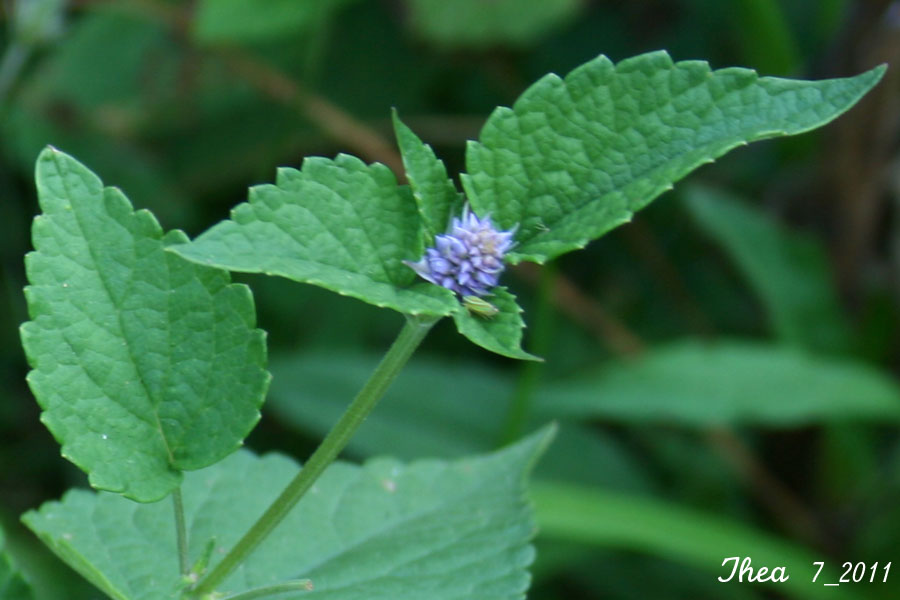
We continued down the garden path dropping to our knees to weed around the blooming thyme.  We also took the time to stop and smell the fragrant white lilies that intoxicated us.  At a particular point where the paths converged, a good distance from where we first started into the garden over the bridge, I was introduced to an herb that I had never met before.  It seemed to stand out from all the rest which was notable since the competition for attention was fierce among the “Dragon’s Lingerie” string beans and colorful self-seeding poppies. I instantly knew that this plant was Rachel’s ally and told her so.  She was curious and asked how I knew this, and what medicine did it have for her.  That was when I noticed the Anglewing Katydid crawling up the stem of this small and seemingly insignificant plant toward its delicate, pale purple wand of a flower.  It was a sign I could not deny. Rachel pinched off a piece of the plant for me to smell and taste – and I fell in love with Anise Hyssop.

Anglewing KatydidAnise Hyssop, Agastache foeniculum is in the mint family, Lamiaceae, and a perennial native to North America.  More resistant to drought than many other members of the mint family it likes to grow at the edge of open woodlands and is considered a cottage garden herb. Cultivated forms of Anise Hyssop are often grown in flower gardens and these cultivars frequently escape and establish populations in the wild. Plants that grow in their native habitat, however, and in soil for which they are designed carry the most potent medicine. More than plants that have been introduced or even naturalized, native plants embody the spirit of place.  The aromatic fragrance, distinct flavor and delicate color of Anise Hyssop would make a believer out of anyone.

Its name derives from the Old English ysope, the Irish Latin hysopus and the Greek hyssopos.  Hyssop is a word of Semitic origin that describes any of several aromatic herbs used medicinally and in purification rites and ceremonial sprinkling.  It is a sacred plant used in Judaism and appears repeatedly in the Hebrew Bible.  It is often used to fill the Catholic ceremonial aspergillum, a liturgical implement, which the priest dips into a bowl of holy water and sprinkles onto the congregation to bless them and to heal the sick.  An aspergillum in the form of a natural brush made from tree branches and twigs is also used by Witches at the ‘Turning of the Wheel’ to cleanse the Circle prior to seasonal rituals and to aid in creating sacred space. Pure spring water, rainwater or water charged with moonlight is used instead of Christian holy water.  But really, its all the same as religious rituals are adapted down through time and are a part of our human evolution. Anise Hyssop is a blessing to any gardener.

Native Americans found many uses for this plant. They included it in their medicine bundles and burned it as incense for protection. Its uplifting fragrance was also used to treat depression. Anise Hyssop made into a poultice can be used to treat burns and in wound healing. As a wash for poison ivy it helped to reduce itching.  Internally it was used to treat fevers, and diarrhea.  It is antibacterial, anti-inflammatory, and very useful as an infusion for relieving congestion. As a medicinal herb it has soothing, expectorant and cough suppressant properties. A tea made from the leaves and flowers is sedating and relieves pain from coughing with chest colds. Used in combination with licorice it is especially effective for lung conditions such as bronchitis and respiratory tract infections.

The foliage of Anise Hyssop actually smells like licorice with complex notes of lemon, pine, sage, black pepper and camphor. There is no floral scent. Leaves and flowers are edible and may be baked in breads or added to salads. It is a feast for the senses and well deserving of its place in the wild garden.  It attracts bees and butterflies but controls pests while encouraging pollination. Deer avoid eating this plant but rabbits love it. Hummingbirds also find it attractive and goldfinches eat its seeds. Rachel had successfully managed to incorporate various aspects of the wild garden into her own promoting biodiversity and benefiting the wider environment.

The first date that I had scheduled with Rachel to connect and spend time with her in the garden had to be rescheduled because she had a bad cough and was down with a cold. I offered to bring her some of my wildcrafted horehound syrup, but she didn’t want to expose anyone and was making teas from herbs in her garden.  Her cough and cold might have been reason enough for Anise Hyssop to be a potential ally. But as Rachel and I continued meandering through her garden that day, we talked about how healing it was to be surrounded by beauty.  We also discovered that we were both incest survivors. This garden that so clearly fed Rachel’s soul was also healing my own.

In herbal medicine a shock or trauma is said to cause what is know as a shen disturbance, or in other words – its causes the shen to flee the physical body. Shen is a concept borrowed from Chinese medicine that equates to “spirit” in Western terms. The shen is seen as residing in the heart and following shock or trauma it must be restored to the heart in order for healing to occur.  The earth-spirit medicine of Anise Hyssop does exactly this, and its flower essence is said to bring back sweetness after the weight of guilt and shame, which is always unwarranted in the case of early childhood sexual abuse. Its flower essence is also used for body-soul integration of pain and suffering.  It is a post-trauma stabilizer aiding the ability to forgive and to accept forgiveness.

There is no question in my mind that we were divinely guided to this sweet little plant that warm summer day in Rachel’s garden.  It is clearly an ally for Rachel, but now it has also become a personal ally of my own.  So if ever you happen to notice an Angel Wing (or Anglewing!) katydid lighting amongst the flowers, best not to be in a hurry or fooled by the disguise. If I were you, I’d let her be my guide.

~ ~ ~

Learn more about Thea’s class Heal Your Heart that teaches about shen disturbances.

Learn more about Thea’s Healing Herbal Retreats and Rachel Clearfield’s magical realism in fine classical oil paintings.

To listen to the song of the Lesser Anglewing Katydid, visit: Microcentrum retinerve

Lesser Anglewing Katydid – Microcentrum retinerve  Photo by Stephen Durrenberger