
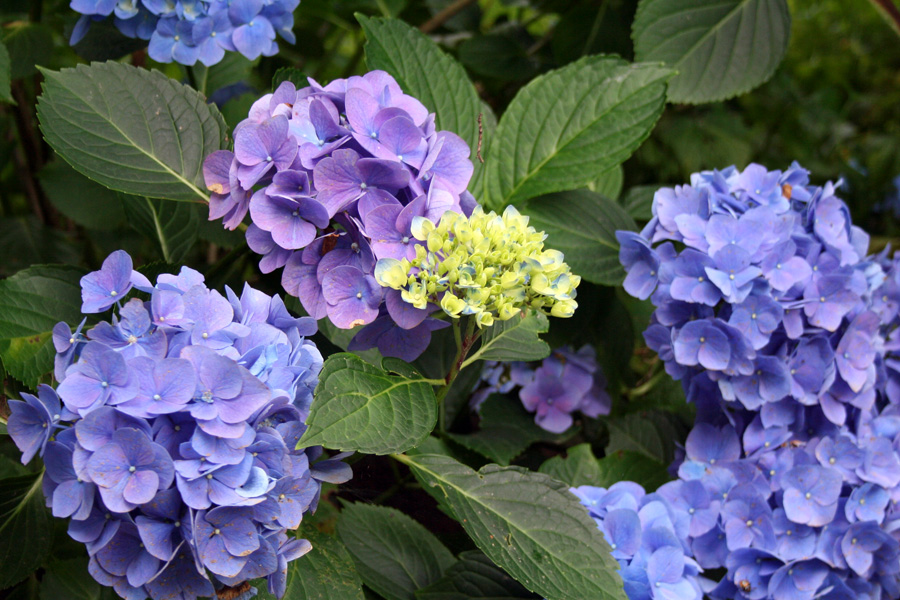
Hydrangea arborescens, Photo by Myrna Attaway
Living on the Blue Ridge of the Southern Appalachian Mountains is a blessing. Multiply that by the abundance of medicinal herbs that also live here, and what you have is a rich haven for herbalists. Having survived the advance and retreat of glaciers during the last ice age, the Appalachians, some of the oldest mountains in the world, became a botanical treasure. It is here that I am blessed to study, gather and prepare herbs, and practice herbal medicine.
I have been coming to these Smoky Mountains of North Carolina for as long as I can remember, and I have lived here full time for the last twenty-four years. Like me, lots of folks are finding their way to the mountains in search of a saner, healthier lifestyle and communities in which to raise families and grow old. Unfortunately, more people also means more scars upon the land. While I believe there is enough for everyone, we also have a responsibility to future generations to be good stewards of the land that feeds, sustains, and heals us. For this reason, I would like to share one of my harvesting expeditions.
 Wild Hydrangea (Hydrangea arborescens) is an attractive shrub but nowhere near as flamboyant as its cultivar cousins cherished as ornamentals. Wild Hydrangea is native to the Southern Appalachians, which has allowed me the opportunity to get to know it more intimately. What I discovered is an excellent remedy for inflamed or enlarged prostate. While not a “prostate” herb, per se, because herbs cannot be that easily pigeonholed, it holds a genetic knowledge of its lineage that stretches back for millennia. That brings forth many healing potentials, and we are still discovering them. To describe Wild Hydrangea as simply a prostate herb would not give it enough credit or the respect it deserves as a wise elder.
The study of an imbalance in a person, such as a prostate issue, is called pathophysiology. Modern Medicine studies pathophysiology from the narrow lens of the reductionist viewpoint because the pharmaceuticals prescribed by its practitioners are narrow in their actions. Herbalists have a broader perspective because the plants they use are broad-acting and have many actions. This broad energetic perspective or holistic view naturally leads to searching for patterns. Energetics is another way of saying patterns of organization.
Patterns of imbalance within our body mirror the patterns found in nature: heat/cold, dampness/dryness, contraction/expansion. Self-organization into ordered patterns is seen everywhere in nature. Studying and learning how to read these patterns will help us understand that healing takes place in the context of relationships. Plants are sentient beings that communicate through biochemistry. The understanding of this chemical language is in its infancy. Energetically, Hydrangea is cool and neutral. Its herbal actions are diuretic, anti-lithic, analgesic, and anti-inflammatory. Its uses include various kidney, gallbladder, and urinary tract problems.
 My first trip into the woods (many years ago now) to identify and harvest Wild Hydrangea was on a Full Harvest Moon with my mentor; herbalist, Patricia Kyritsi Howell. It was the perfect time to go digging for Hydrangea’s roots. We carried a basket, canvas bag, and hand clippers into the North Georgia woods. The white flower clusters that bloom May through July were faded and brown but still clung to the shrubs that grow between four to six feet tall. The opposite, broadly ovate and sharply toothed edges of the leaves that are slightly paler underneath made the identification easier for us in the absence of bloom. The stem bark tends to peel off in thin layers, each a slightly different color and thus the common name, Sevenbark.
 Patricia writes about Wild Hydrangea in Medicinal Herbs of the Southern Appalachians. I was thrilled that she had agreed to provide me with a personal introduction to this native plant. We walked on through the woods until she stopped and pointed out a few shrubs growing on a steep slope. Getting to them would be difficult. Following Patricia’s lead, I clamored up the bank, digging my heels into the soft, deciduous dirt. Then I began to dig beneath the plant. That was no easy root to free from its tenacious hold. I sweated and dug, pulled, and cut until I held its amazing rhizome and wildly branching root in my hand. I filled the gaping hole that remained with as much dirt and leaf litter as I could manage and clamored back down.
When I turned and looked back up the steep slope, it appeared like a bear had been digging there. I had taken the root of one of three Hydrangea plants that grew in that spot, knowing the importance of leaving enough to ensure continued propagation. Then we decided to climb up to the ridge above the hillside to continue our search. I thought it might be easier to dig from above rather than climb up from below. Not too far from where I had dug up the first Hydrangea root, I saw another small grouping of the shrubs. In the end, I would dig three roots but not before I climbed down over the edge of the bank I had previously climbed up. While hanging off the side, I lost my footing with nothing to hold me but my body pressed against the loose, humus-rich soil and one hand clinging to this small but deep root. I looked down and realized the slide and tumble to the bottom would not be pretty. If I went down, it was going with me. So I dug my heels in deeper while freeing the root from its tenacious hold with one hand and managing to grab a vine with the other, pulling myself up just enough to get one foot in the hole left by the root, enough to propel myself up over the top of the bank. I was very grateful that I didn’t crash and burn. Life, after all, is an adventure.
That gave me a deeper appreciation for the roots of plants that hold and support the soil and its microorganisms on steep mountain slopes. My clamoring had left the mountainside unmistakably vulnerable to erosion even though I had done my best to fill in the holes. We should never underestimate the impact on natural systems when imposing our needs. May we always do our best to keep that impact to a minimum and never take it for granted. I thanked the rich soil beneath my feet and Hydrangea for its medicine root. Three roots were all I needed. Not taking more than we need is one of the keys to ethical harvesting.
Wanting to have enough plant material on hand for making medicine, I had bought some dried and sifted Hydrangea root from a wholesale distributor. But I also knew that preparing local wildcrafted medicines is 1000 times more potent energetically than commercially prepared medicines. These roots that we had gathered would become fresh root tincture started on the full moon and decanted on the new or dark moon — dark like the earth in which she grew. The roots would more readily release their medicine and active constituents during this phase of the waning moon.
“So that’s all you need?” Patricia inquired. And my response was, “Yes, it is enough.” I had accomplished what I had come for: to feel, smell and connect with the medicine plant that was serving my clients. Sometimes healing takes a certain kind of aggressiveness, a willingness to go that extra mile or climb that mountain. Patricia then made a very thoughtful suggestion, “Add a little of the fresh wild root tincture to the commercial dried root tincture. It will remind it of who it is,” and that this is where it came from.
 All content except where otherwise noted © 2015 Thea Summer Deer (newly updated and revised in 2022)
References:
Thomas Easley in Conversation with Jesse Wolf Hardin, Herbaria, Plant Healer Magazine, March 24th, 2015
Resources:
Medicinal Herbs of the Southern Appalachians, by Patricia Kyritsi Howell
Hidden Treasure: Kidney Essence & the Water Element at Five Element Academy


 Wisdom of the Plant Devas